THE MATERIAL
BEHIND EVERY
STICKER
Single-colour cut vinyl. Plotter-cut, weeded by hand. Made to last for years outdoors.
// WHAT IT IS
Adhesive vinyl:
what it is and
why we use it
Adhesive vinyl (calendered PVC) is a thin, flexible plastic film with a permanent adhesive layer on its back. It is the industry standard for signage, lettering and custom stickers for several reasons:
UV RESISTANCE
Does not fade with prolonged sun exposure. No yellowing or colour loss when used outdoors.
WATERPROOF
Withstands rain, snow, humidity and pressure washing without peeling or deteriorating.
FLEXIBILITY
Adapts to curved surfaces without wrinkles or breaks. Perfect for laptops, helmets and bottles.
PERMANENT ADHESION
Sticks to metal, glass, smooth plastic and more. Holds for years with no lifted edges.
PRECISION CUT
Allows complex die-cutting with precision plotters. Clean edges, no burrs.
Your design,
your colour,
your size
15 professional vinyl colours and multiple small-format sizes per design. Choose the perfect combination for your project.
Each design comes in 10 to 25 sizes. The size always refers to the short side of the design; the length adjusts proportionally. 1 cm increments.
Bottle
Guitar
Fridge
Motorbike
Camper van
The vinyl has UV ray protection. That means you can leave it in the July sun in southern Spain and it won't turn yellow or lose colour. Tested from -20 to +60 degrees.
Rain, puddles, pressure washing at the car wash. Water does nothing to it. If you stick it on your car, you can wash it with complete peace of mind.
Over 5 years outdoors on bodywork, glass or painted metal. Indoors (laptop, wall, fridge), practically indefinite. That is the lifespan of the material, not a marketing promise.
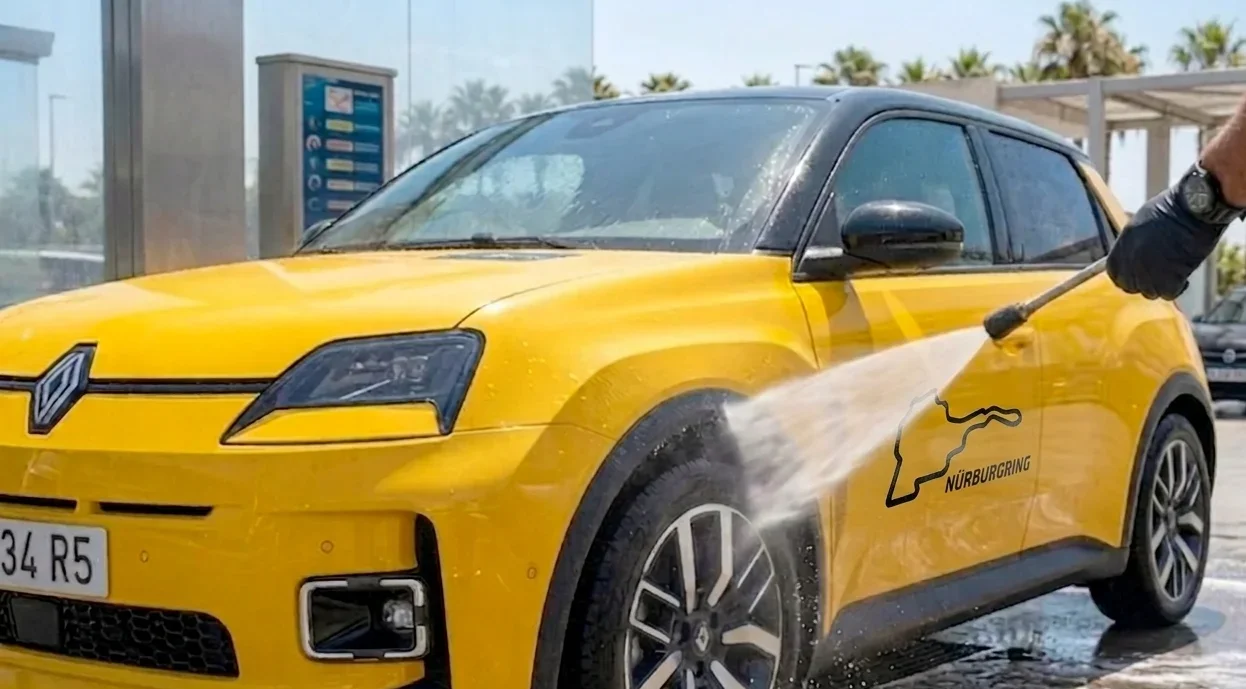
It is hardly ever the weather. It is the surface and how it was applied:
• Porous, rough or silicone-treated surfaces (some plastics, untreated wood) grip worse.
• Sticking over dust, grease or wax leaves bubbles and edges that lift over time.
• Pressure washing very close to the edge can lift a corner.
How to apply it properly, wash it and remove it is covered in the sticker FAQ.
Three steps to make it last for years
CLEAN THE SURFACE
Use a cloth with alcohol or glass cleaner. The surface must be dry, free of dust and grease.
Read moreRead less
The foundation: a spotless surface
90% of vinyls that peel off prematurely fail due to poor surface preparation, not the adhesive.
What to use
Alcohol or glass cleaner. Apply with a clean microfiber cloth. Avoid paper towels.
Special surfaces
On freshly waxed cars, clean twice. On glass, no rain-repellent residue. Golden rule: if you feel something, it's not ready.
PEEL AND APPLY
Remove the backing paper. Place from one edge pressing towards the other to avoid bubbles. If any remain, prick with a fine needle.
Read moreRead less
The professional technique
Fold a corner and peel gradually while pressing from the center outward.
Bubbles
Prick with a fine needle at an angle. In 24-48 hours micro-bubbles usually disappear on their own.
REMOVE THE TRANSFER
All our stickers include a transfer sheet. Peel it slowly at a 45-degree angle. If it resists, press again and wait a few minutes.
Read moreRead less
The 45-degree rule
Always pull at 45 degrees, slowly and steadily. If it resists, press for 10 seconds and retry.
The final result
The premium relief of Pegame's pure vinyl looks amazing. No white edges, no backgrounds. That's real cut vinyl.



It's not paper, it's not just any plastic
Imagine a thin, flexible sheet, similar to the feel of a credit card but much thinner. That's vinyl. A material that sticks to almost any smooth surface and, once applied, looks like it's painted on.
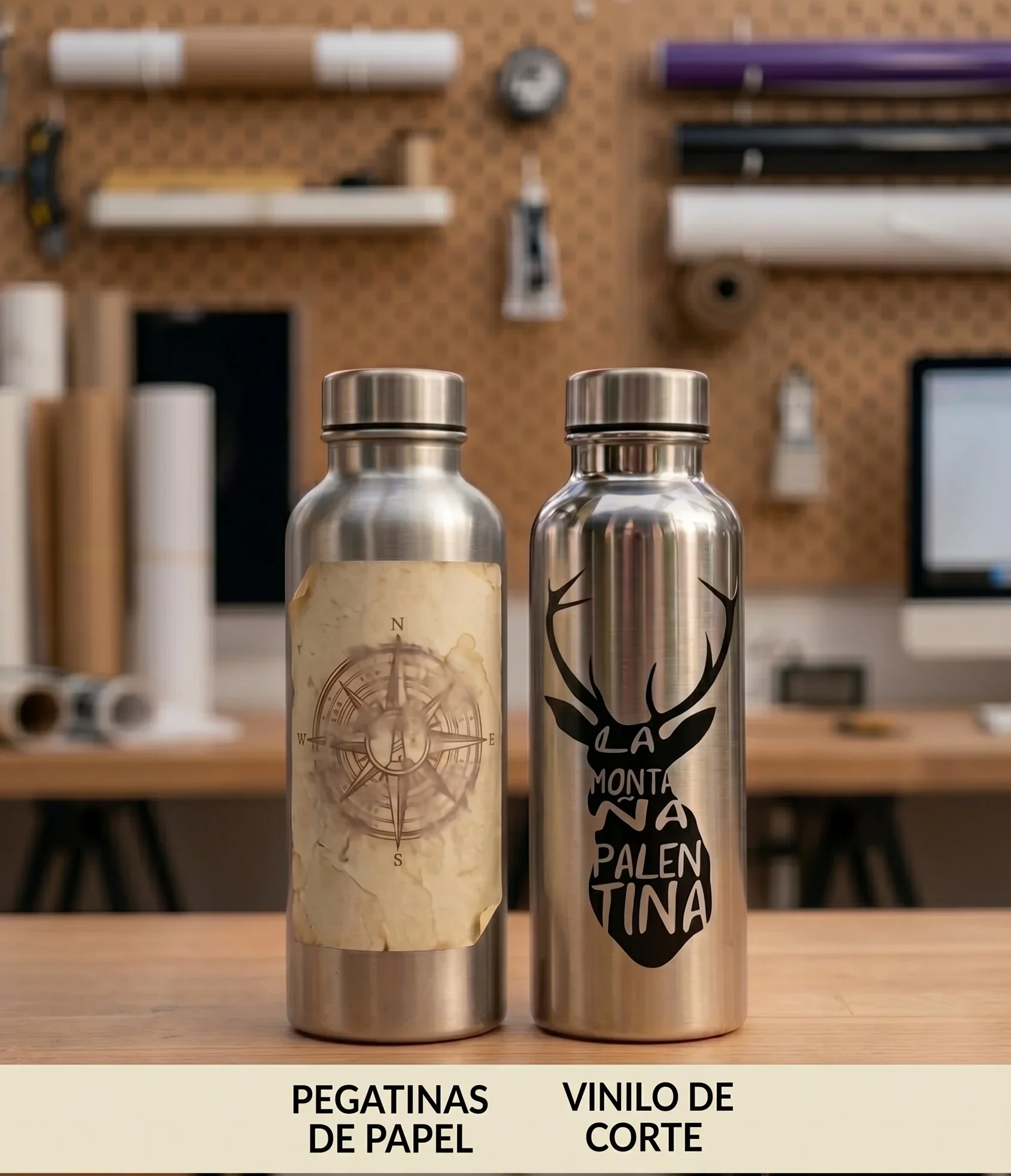
Unlike typical paper stickers (the kind that turn white in the rain and peel off in the sun), cut vinyl is a layer of solid colour. There's no ink on top: the colour IS the material. That's why it doesn't fade, doesn't scratch easily and lasts for years.
At Pegame we use professional cut vinyl. Each design is cut with a precision plotter (a machine that cuts following the exact contour of the design), hand-weeded to remove excess material and prepared so you can stick it on easily yourself.
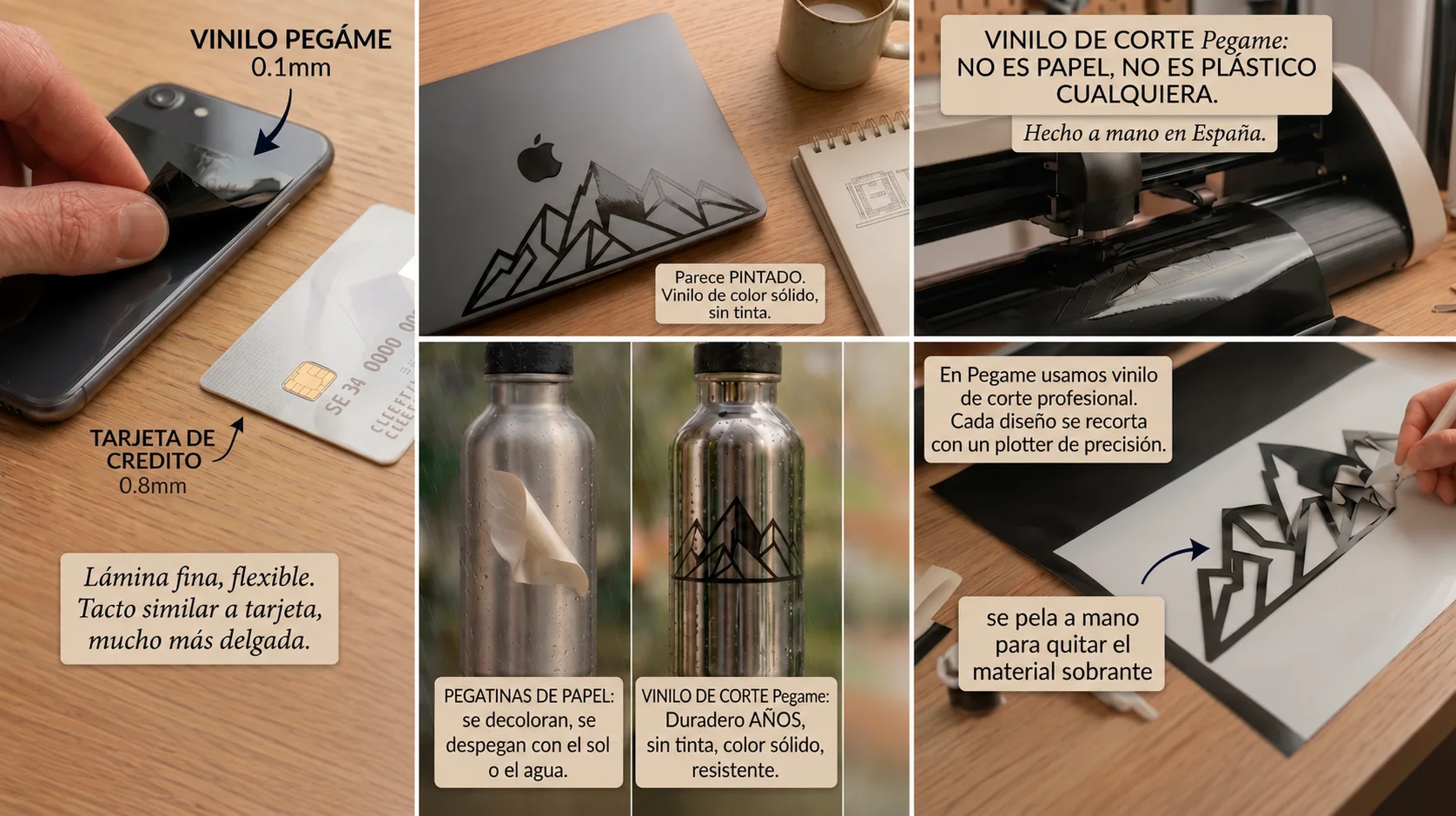
Four steps, three of them by hand
The plotter cuts the design out of the vinyl roll with a blade. It is the only automatic part of the process.
With tweezers, all the excess vinyl around and inside each shape is removed by hand. This is the step that defines quality: a badly weeded letter counter shows from a metre away.
A carrier sheet is applied over the weeded design to keep every piece in place until it reaches your surface.
Each piece is checked one by one and prepared for shipping.
That is why the price does not drop with quantity the way it does at a print shop: sticker number three hundred costs practically the same as the first. What does change the price is size and level of detail, because both make weeding take longer.
• Ink printed on paper or thin plastic
• Fades in the sun within weeks
• Water wrinkles and peels it
• Has a white or transparent background
• Lasts months, not years
• The colour is the material, no ink involved
• UV protection: doesn't lose colour
• Resistant to water, pressure washing
• No background: just your design, clean
• Over 5 years outdoors
No background, no white edges
When you apply cut vinyl, you don't get a rectangle with the design inside. You get just the design. No white background, no transparent border, no frame. As if it were painted directly onto the surface.
Also, the vinyl has a slight relief you can feel when running your finger over it. It's subtle, but you notice it: it is the difference between something stuck on and something integrated.
The price of carrying no ink is that every sticker is one single colour, chosen from 15. No photos, no shading, no two tones in the same piece. And clean shapes win: logos, text, silhouettes and well-defined lines come out perfect; very fine details can get lost when cutting and weeding, so at small sizes we simplify them a little.
The colours are solid with a gloss finish and a hint of reflection. Because the colour is the material itself, what you see on the colour chart is what you get.