The bust of NefertitiOver 3,300 years, an empty eye and a claim that won't go away
You have probably seen her a thousand times without knowing her name: a woman with a long neck, a calm gaze and a tall, flat-topped blue crown. She is on postcards, in schoolbooks, on mugs, on T-shirts and in every museum shop. It is the bust of Nefertiti, and it may well be the most copied face of the ancient world.
But behind that calm lies a story with everything: a workshop buried under the sand, an eye that never turned up, a share-out Egypt has been disputing for a century, a war, a salt mine and another face hidden under the plaster.
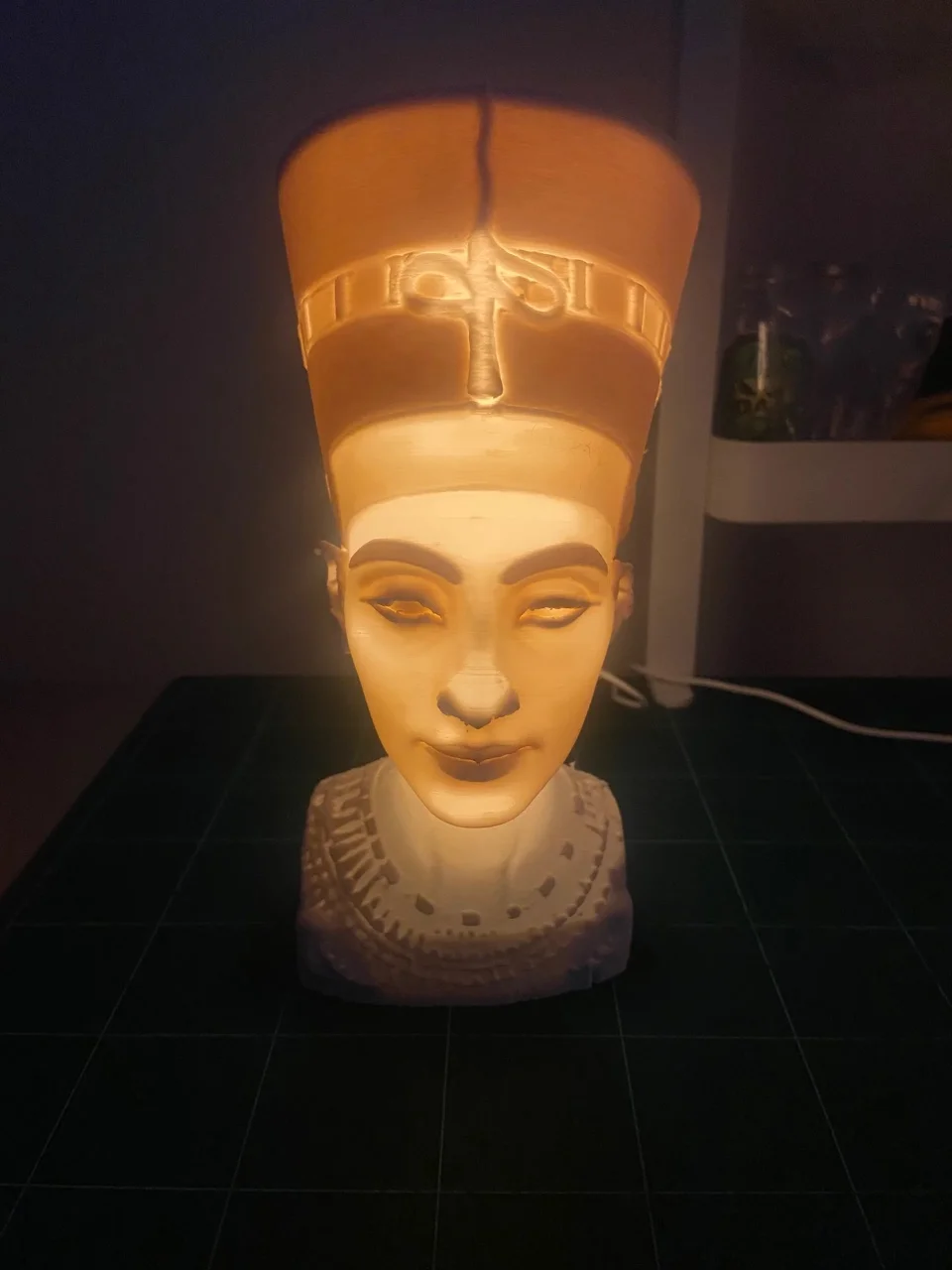
Here it is. And at the end, we tell you why we are turning her into a lamp.
"The beautiful one has come"
That is what her name means in ancient Egyptian: Nefertiti, "the beautiful one has come". She was the great royal wife of the pharaoh Akhenaten, around the middle of the 14th century BC, and she lived through one of the strangest moments in all of Egypt's history.
Akhenaten broke with centuries of tradition. He set aside the old gods to worship just one, the Aten, the disc of the sun, and built a brand-new capital from scratch in the middle of the desert, Akhetaten, today's Amarna. Art changed with him too: stiff, solemn figures gave way to softer, more intimate, almost homely portraits.
Nefertiti was no decorative queen. She appears in reliefs at the same size as the pharaoh, smiting enemies, leading offerings to the sun with her six daughters. Then, towards the end of the reign, her trail goes murky. Some think she died; others believe she ruled under another name. Her mummy has never been identified with certainty. Of the most famous woman of Amarna, what we have left is, above all, a face.
6 December 1912
When Akhenaten died, his successors abandoned Amarna and the city emptied. The sand did the rest. More than three thousand years later, a German expedition led by the archaeologist Ludwig Borchardt was digging what had once been a craftsmen's quarter. In one of the houses, identified as the workshop of the sculptor Thutmose, they found a storeroom full of portraits: half-finished heads, plaster studies, working pieces.
And among them, face down on the floor, a bust of painted limestone almost half a metre tall, its colours still bright. Borchardt wrote a line in his excavation diary that has been quoted thousands of times since:
"Describing it is useless. You have to see it."
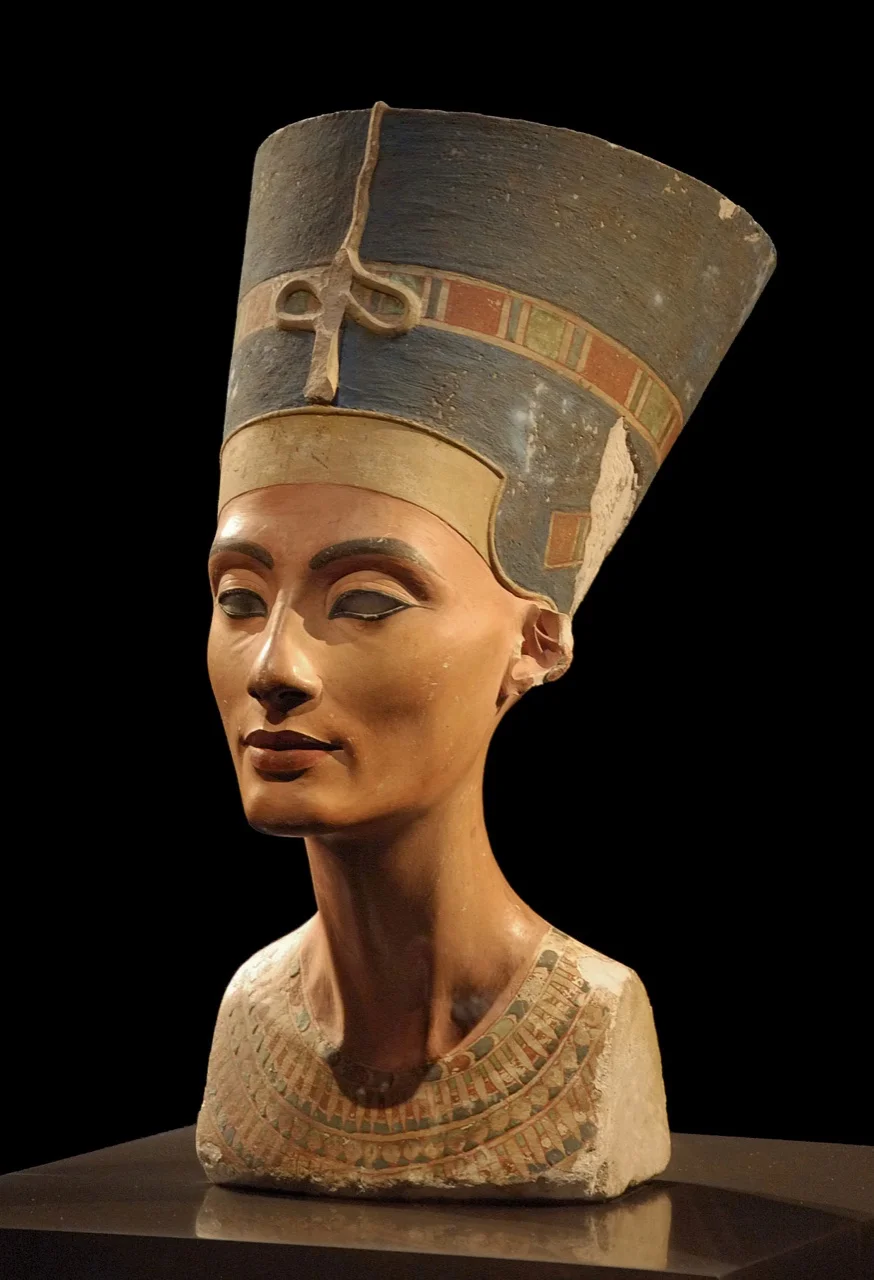
There was one odd detail: the left eye was missing. The right one has a quartz inlay with a painted pupil; the left is empty, bare stone. Borchardt offered a reward to whoever found the piece and had the workshop rubble sifted. It never turned up.
Several explanations are still in play. That the bust was never meant for display but was a workshop model Thutmose used to show his assistants what the queen looked like, and so was never finished. That the eye fell out when the workshop fell into ruin. Or, the most novelistic, that Nefertiti herself had lost that eye. None has been proven.
A share-out with small print
At the time, whatever a foreign excavation found in Egypt was divided up: one part for the Egyptian Antiquities Service, then run by the French, and another for whoever had paid for the dig. In January 1913, Borchardt sat down with the inspector in charge of the division. The bust ended up in the German lot and travelled to Berlin, into the hands of the excavation's patron, the businessman James Simon, who years later donated it to the city's museums.
What happened at that table is where the controversy starts. According to the version Egypt defends, Borchardt hid what it was worth: he described it as a plaster bust of a princess and showed a photograph that did it no justice. According to the German version, the division followed the rules, was signed by both sides, and the bust was listed as the main piece.
For eleven years, hardly anyone saw it. When it was finally shown to the public in Berlin in 1924, it was a sensation. And Egypt asked for it back that same year. It has asked again and again ever since: with threats to close its sites to German archaeologists in the 1920s, with campaigns by its antiquities ministers, and once more with the opening of the Grand Egyptian Museum in 2025. The bust is still in Berlin.
A war, a salt mine and a museum split in two
The queen who had spent three thousand years under the sand was not going to have a quiet 20th century. When the bombing of Berlin began, the museums took their treasures out of the galleries. The bust went through vaults and bunkers until, in the last months of the war, it ended up at the bottom of a salt mine in Thuringia, alongside paintings, gold and works from half of Germany.
American soldiers found it there in the spring of 1945. It went to an Allied depot in Wiesbaden, where rescued works of art were gathered, and was put on display again there. It did not return to Berlin until the 1950s, and to a divided city: it stayed in the West, while the building where it had been unveiled in 1924, the Neues Museum, still lay in ruins in the East.
- 1912Found in Thutmose's workshop at Amarna.
- 1913The finds are divided; it travels to Berlin.
- 1924First shown to the public. Egypt asks for it back.
- 1945Found by the US Army in a salt mine.
- 1950sReturns to Berlin, on the western side.
- 2009Back in the Neues Museum, rebuilt after the war.
Since 2009 it has lived in the Neues Museum again, in a room of its own. Almost a century later, it is back in the house where it was first shown to the world.
Another face, under the plaster
The bust is not simply carved stone. Thutmose sculpted a limestone core and then covered it with layers of gypsum stucco, thicker in some places than others, on which he modelled the final details and applied the paint. What we see is the skin; underneath there is another sculpture.
In 2006, a medical team put it through a CT scanner, the same kind of machine used in hospitals. The results, published in 2009, surprised everyone: the face carved in the stone is not the same as the one outside. It has creases by the mouth and on the cheeks, and a small bump on the bridge of the nose. The stucco smooths them all away.
Nobody knows whether it is a truer portrait of the real Nefertiti, a first version the sculptor corrected, or just a working base. But the idea is beautiful: the perfect face we know is a layer, and beneath it lies another, more human one, that you only see if you look through.
The most copied face in the world, now made of light
There are plenty of reasons this bust became an icon. It is a colour portrait more than three thousand years old, which is extremely rare. Her face is almost perfectly symmetrical, except for that empty eye that makes her human. And her profile, that long neck holding up an impossible crown, is recognisable from a hundred metres away. That is why there are replicas in every museum shop and her silhouette turns up in adverts, posters and tattoos.
In the workshop we asked ourselves a different question: what if Nefertiti were painted not on the outside, but on the inside? Switched off, she would be a white bust, clean, almost like plaster. Switched on, the light would have to pass through her and, as it did, draw her brows, her eyes, her lips, the bands of the crown and the collar. The same idea as Thutmose's: one face on the outside and another that only appears if you look through.
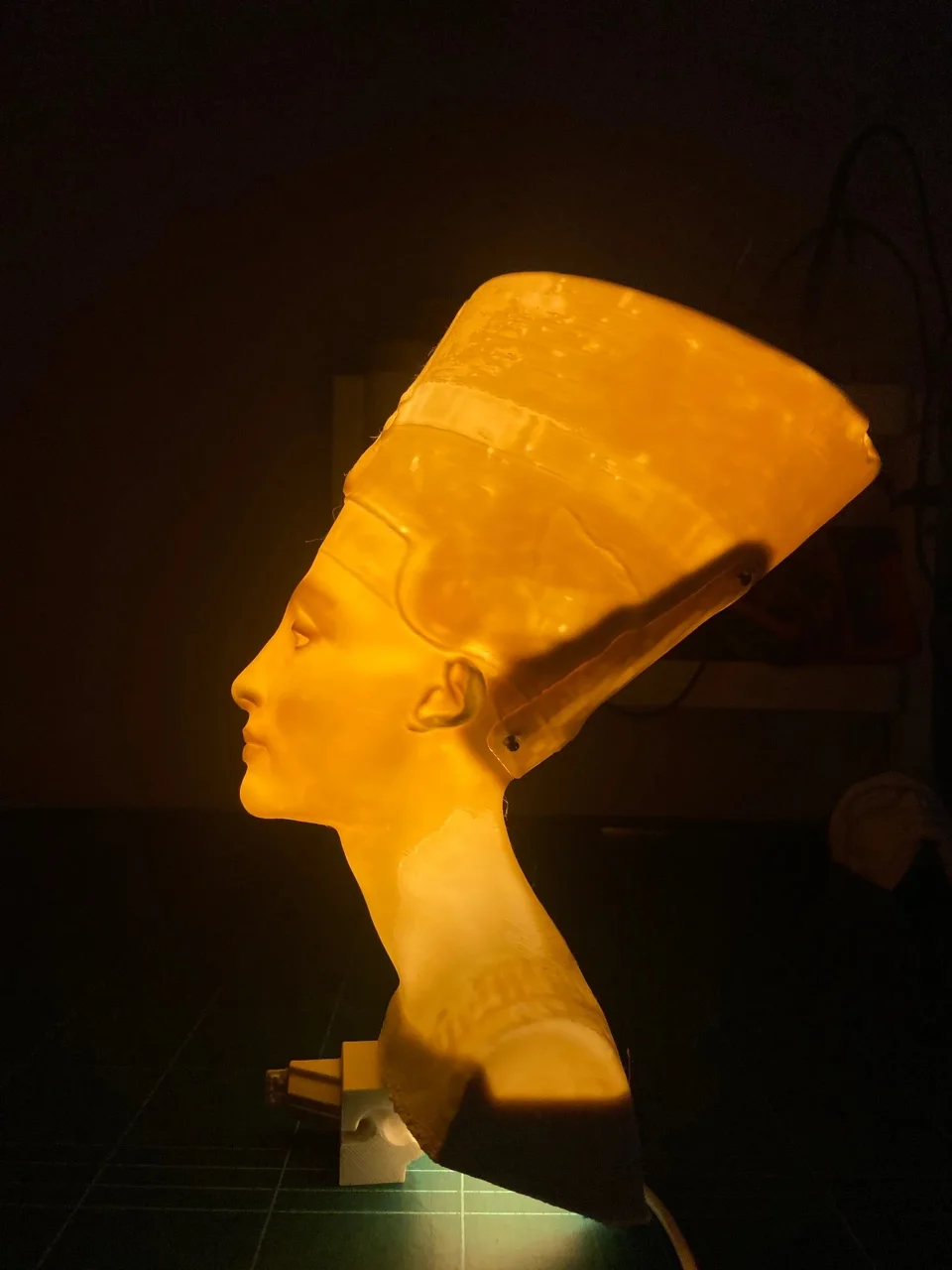
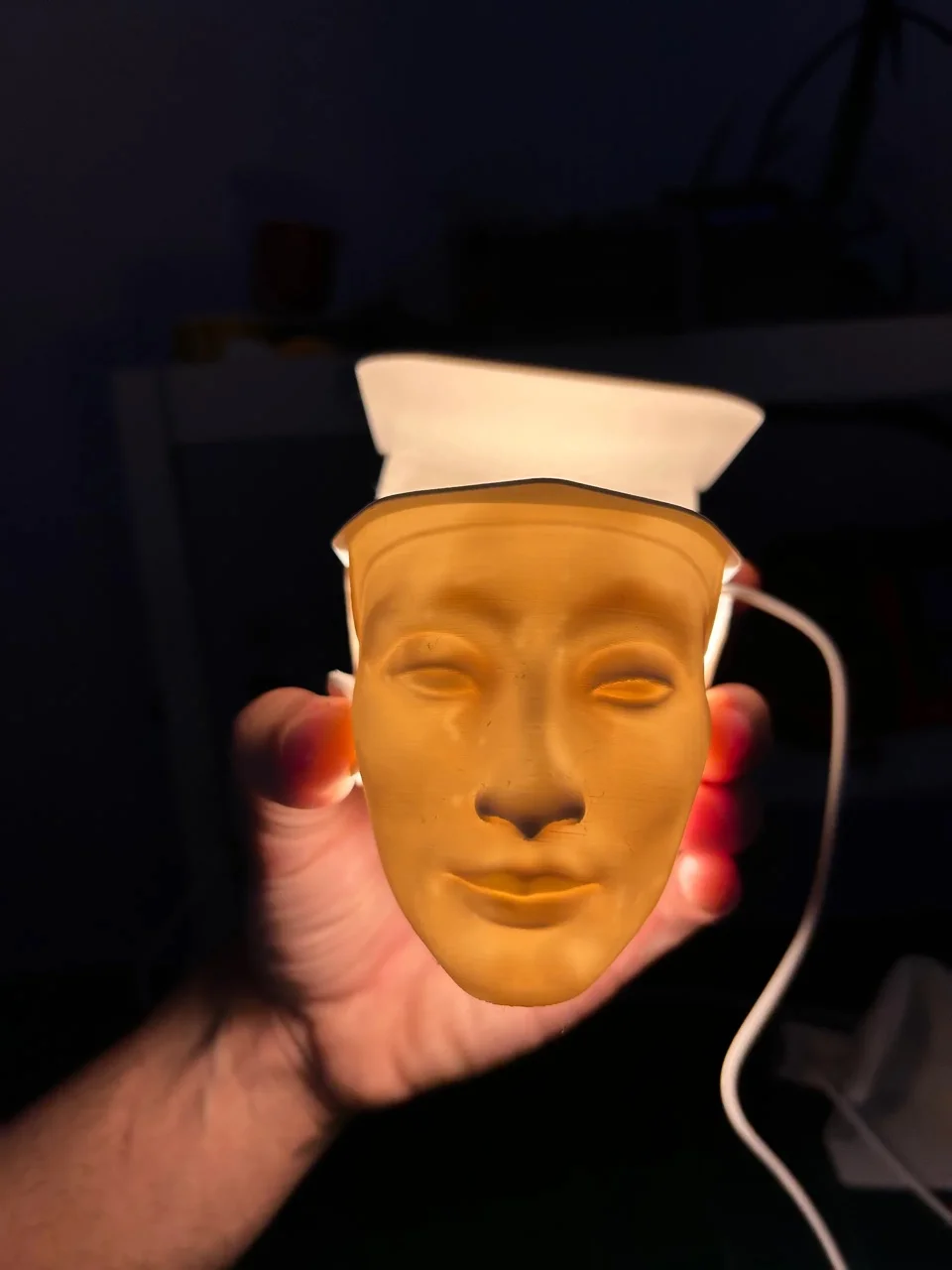
It is the same technique as our lithophanes, where the image is made of thicknesses, taken to a whole sculpture. And it has not been easy: we have spent weeks on 3D-printed prototypes, parts that would not fit, a button that took more revisions than we would like to admit and a nose that insists on coming out black.
We will tell the whole story in the next posts on this blog. How you decide where the light goes inside a head, why parts that look perfect on screen fail, and how you paint a face without paint. Nefertiti waited three thousand years under the sand; we are not far off switching her on for good.
Frequently asked questions about the bust of Nefertiti
Where is the bust of Nefertiti?
In the Neues Museum in Berlin, on Museum Island, where it has had its own room since 2009. It had already been shown in the same building before the war, from 1924.
Who made the bust of Nefertiti, and when?
It is attributed to the sculptor Thutmose, because it was found in his workshop at Amarna. It was made around 1345 BC, during the reign of Akhenaten, Nefertiti's husband.
What is it made of, and how big is it?
It has a limestone core covered in layers of painted gypsum stucco. It is about 48 centimetres tall and weighs about 20 kilos.
Why is one eye missing from the bust of Nefertiti?
Nobody knows for sure. The right eye has a quartz inlay; the left either never had one or lost it. The most widely accepted explanation is that it was a workshop model that was never finished; others say the inlay fell out, or that the queen had lost that eye.
Why does Egypt want the bust of Nefertiti back?
Because it believes the bust left the country through deception in the 1913 division of finds: the archaeologist Ludwig Borchardt is said to have hidden its value from the Egyptian inspector. Germany maintains the division was legal. Egypt has been asking for it since 1924.
What was discovered inside the bust?
A 2006 scan revealed that the face carved in the stone, under the stucco, has creases by the mouth and a small bump on the nose that the outer layer does not show.